§ RESEARCH · CJC-1295
The record, paper by paper.
The published mechanism, the Phase 1 data, the preclinical rescue work, and the regulatory tail — read in chronological order.
What the research actually says
The published human evidence for CJC-1295 is narrow and specific: a discovery paper in rats in 2005, a Phase 1 pharmacokinetics study in healthy adults in 2006, a companion study confirming growth hormone pulsatility is preserved, and a 2009 analysis of downstream serum proteins. That is close to the complete human record. A Phase 2 trial in 192 people with HIV-associated visceral obesity was discontinued in late 2006 after a participant death judged unrelated to the compound, and its primary efficacy endpoints were never published. A related compound, tesamorelin — without the albumin-binding modification — was approved by the FDA in 2010 for HIV-related fat accumulation on the strength of completed clinical trials. CJC-1295, the long-acting version, was never approved and was not recommended for compounding pharmacy access at the 2024 FDA advisory committee review.
Mechanism: what the receptor is doing
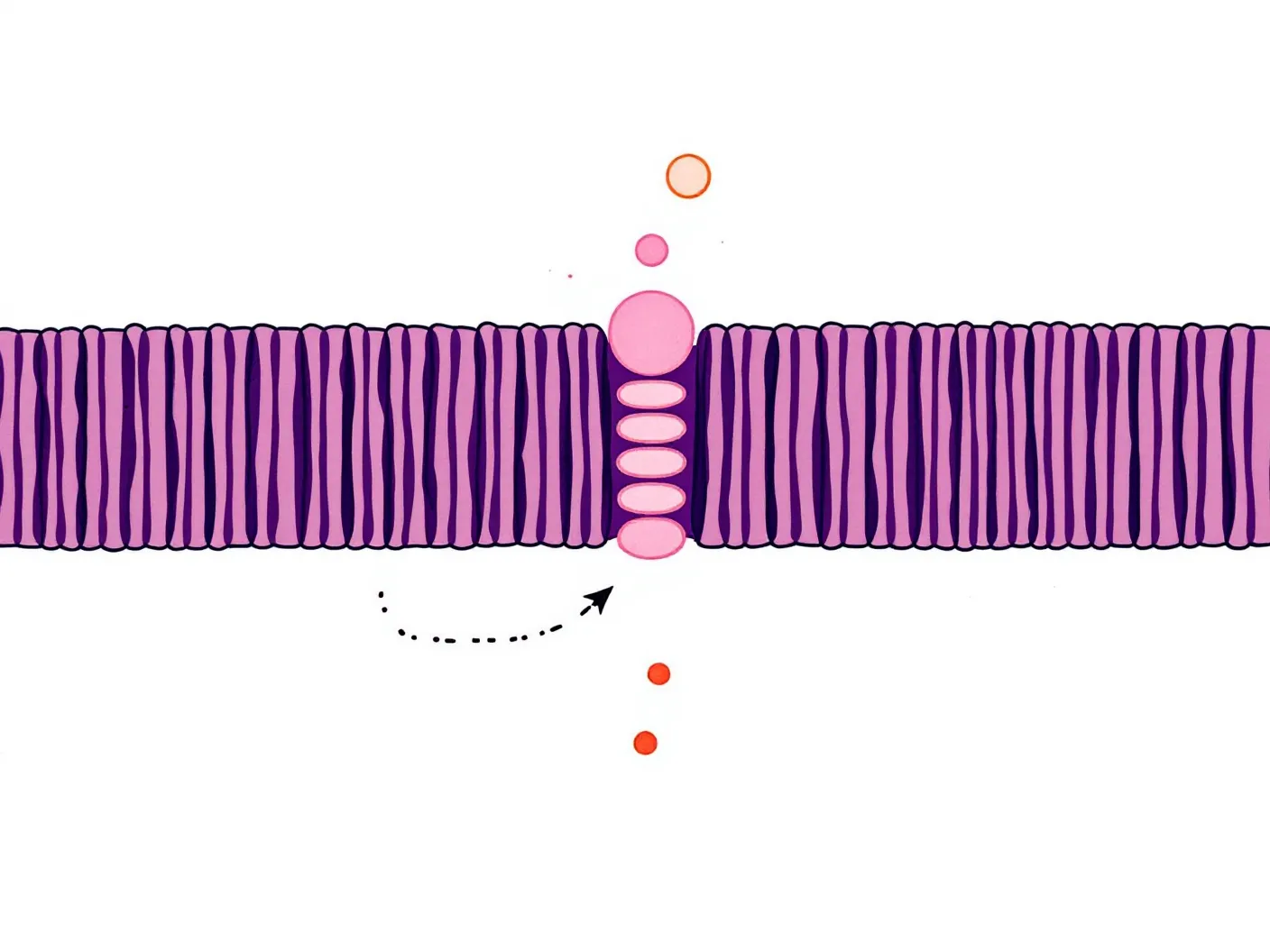
CJC-1295 binds the growth hormone-releasing hormone receptor — GHRHR — a class-B G-protein-coupled receptor expressed predominantly on somatotroph cells of the anterior pituitary. The receptor's natural ligand is the 44-amino-acid hypothalamic peptide GHRH, which travels through the hypophyseal portal vasculature to its target. Receptor activation triggers a Gs/adenylyl cyclase/cAMP/PKA second-messenger cascade. The downstream consequences are upregulation of growth hormone gene transcription, somatotroph proliferation, and vesicular release of GH into systemic circulation. Hepatic IGF-1 follows [1][2].
The chemistry that distinguishes CJC-1295 from its natural ligand sits at four positions. D-alanine at position 2 of the GRF(1-29) backbone blocks DPP-4-mediated N-terminal dipeptide cleavage, the dominant clearance pathway for native GHRH. Glutamine at 8, alanine at 15, and leucine at 27 close additional degradation routes — deamidation and oxidation [1][8]. Those substitutions alone extend the in-vivo half-life from roughly seven minutes (native GHRH) to approximately thirty minutes (modified GRF 1-29) while preserving GHRH-receptor binding affinity [8].
The DAC platform adds one more move. A maleimidopropionic acid group is appended to the C-terminus. After subcutaneous injection, that maleimide undergoes a Michael-addition reaction with the free thiol on cysteine 34 of serum albumin. The peptide becomes covalently linked to albumin and inherits albumin's slow multi-day clearance. The resulting plasma half-life in healthy adults runs between 5.8 and 8.1 days [3].
Jetté 2005: the discovery paper
The molecule entered the literature in March 2005. Jetté and colleagues at ConjuChem published "Human growth hormone-releasing factor (hGRF)1-29-albumin bioconjugates activate the GRF receptor on the anterior pituitary in rats" in Endocrinology [1].
The paper characterized a series of hGRF(1-29) bioconjugates and identified one — given the development designation CJC-1295 — as the lead long-acting candidate. In rats, a single subcutaneous bolus produced a fourfold increase in growth hormone AUC over two hours compared with the unconjugated peptide. Bioactivity in circulation persisted for more than seventy-two hours. The pharmacodynamic signature — sustained GH elevation from a single subcutaneous injection — was the structural achievement the team was after.
The paper also established that the receptor affinity of the modified-and-tethered peptide was preserved. The bioconjugate bound the GHRH receptor with potency comparable to the unmodified GRF(1-29). The extended half-life did not come at the cost of activity.
Teichman 2006: the human Phase 1
The human study followed a year later. Teichman, Neale, Lawrence, Gagnon, Castaigne, and Frohman published "Prolonged stimulation of growth hormone and insulin-like growth factor I secretion by CJC-1295, a long-acting analog of GH-releasing hormone, in healthy adults" in JCEM in February 2006 [2][3].
The design was a randomized, placebo-controlled Phase 1 with both single-dose and multiple-dose cohorts. Single subcutaneous doses at 30, 60, 125, and 250 μg/kg were given to cohorts of approximately eleven healthy adults each, with placebo controls. Multiple-dose cohorts received weekly or biweekly injections over twenty-eight to forty-nine days.
The results were straightforward. Mean plasma GH rose two- to tenfold in a dose-dependent pattern and remained elevated for at least six days after a single injection. Mean IGF-1 rose 1.5 to 3-fold and remained elevated for nine to eleven days. In the multiple-dose cohorts, IGF-1 elevation was sustained for up to twenty-eight days [2].
The pharmacokinetic estimate of the mean plasma half-life of CJC-1295 across dose cohorts was 5.8 to 8.1 days [3]. That number is the most-cited single fact about the molecule. The mechanism — covalent bioconjugation to serum albumin at Cys34 — was confirmed.
Adverse events in the published cohorts were predominantly local. Injection-site reactions — pain, swelling, induration — were the most common. Systemic adverse events were uncommon at the 30 and 60 μg/kg dose levels [18]. The published Phase 1 supported tolerability in short-duration single- and multi-dose use in healthy adults.

Ionescu 2006: pulsatility preserved
An immediate question for any drug that produces sustained GH elevation is whether it suppresses the pituitary's natural pulsatile rhythm. Native GH release in humans occurs in discrete bursts several times per day, not as continuous tonic output, and that pulsatility is thought to be important for the differential biological effects of GH across tissues.
Ionescu and Frohman addressed that question in a companion Phase 1 pharmacodynamic substudy, also published in JCEM in 2006 [4]. A single subcutaneous dose of CJC-1295 raised the basal trough GH approximately 7.5-fold and elevated mean GH approximately 46 percent above baseline. The pulsatile pattern of secretion persisted. The pituitary continued to release GH in bursts; the bursts simply sat on a higher baseline.
The finding distinguishes CJC-1295's GHRH-analog mechanism from exogenous recombinant GH, which delivers a flat continuous load and does not preserve pulsatility. It also distinguishes it from the broader question of whether sustained continuous stimulation of the somatotropic axis differs in long-term consequence from natural physiological dynamics — a question the published literature does not answer.
Alba 2006: the knockout-mouse rescue
Alba, Fintini, Sagazio, Lawrence, Castaigne, Frohman, and Salvatori published a preclinical rescue study in the American Journal of Physiology — Endocrinology and Metabolism in 2006 [5]. The model was the GHRH-knockout mouse — animals genetically unable to produce endogenous GHRH and therefore stunted in linear growth and lean body composition.
The protocol used 2 μg per injection (approximately 80 μg/kg in a 25 g mouse) at 24-, 48-, or 72-hour intervals over five weeks. Once-daily dosing normalized body length, body weight, and lean composition to wild-type comparators. Less-frequent dosing produced partial restoration. Pituitary somatotroph proliferation increased; GH mRNA expression rose.
The study mattered as proof of concept for the GHRH-analog mechanism: even in an animal lacking endogenous GHRH, exogenous administration of a long-acting GHRH receptor agonist restored somatotropic-axis output to a near-normal pattern. It also established a dosing-interval relationship — that the multi-day half-life of CJC-1295 permits less-than-daily administration without losing efficacy.
Sackmann-Sala 2009: serum biomarkers
Three years after the Phase 1, Sackmann-Sala, Ding, Frohman, and Kopchick published a proteomic analysis of serum from eleven healthy young men one week after a single CJC-1295 injection [6]. Two-dimensional gel electrophoresis and mass spectrometry identified five differentially expressed serum proteins.
Apolipoprotein A1 and transthyretin isoforms decreased. β-hemoglobin, albumin C-terminal fragments, and immunoglobulin fragments increased. The immunoglobulin and albumin fragment signal correlated linearly with IGF-1 levels.
The paper is small and it is the only published proteomic characterization of CJC-1295 exposure in humans, but it is one of the few studies that traced downstream biomarker dynamics beyond GH and IGF-1 themselves. It also remains, almost twenty years later, the most recent peer-reviewed human pharmacodynamic publication on the molecule.
NCT00267527: the trial that ended
The Phase 2 program was meant to be the inflection point.
The ClinicalTrials.gov record for NCT00267527 describes a Phase 2 study in 192 participants with HIV-associated visceral obesity. The dosing regimen was weekly subcutaneous injection, though the full μg/kg specification was not published before the trial was terminated [7].
In October 2006, after the eleventh weekly dose in one participant, that participant died from an acute coronary event approximately two hours post-injection. An independent review attributed the event to pre-existing undiagnosed coronary artery disease and judged it unrelated to study drug. The trial was halted [7].
ConjuChem did not restart the program. Primary efficacy endpoints were never published. No subsequent sponsor has advanced CJC-1295 through any further clinical trial. The molecule's clinical development effectively ended in 2006.
That absence of completed Phase 2 data is the load-bearing fact about CJC-1295's status. The closely related, structurally similar tesamorelin — also a modified GRF(1-29) analog, without the DAC tether — was developed by a separate sponsor and approved by the FDA in 2010 for the same general indication (HIV-associated lipodystrophy), with randomized clinical trial data showing 15-20 percent reduction in visceral adipose tissue over 26 weeks [17]. Tesamorelin's success in the same therapeutic space underscores what CJC-1295's halted program did not establish.

Detection and forensic identification
Two strands of analytical chemistry literature have grown up alongside CJC-1295's research-chemical and athletic-use history.
In 2010, Henninge and colleagues at the Norwegian anti-doping laboratory used LC-HRMS/MS sequence determination to identify an unknown pharmaceutical preparation as CJC-1295, confirming illicit availability and validating an analytical method for forensic identification of seized material [11].
In 2024, Thomas and colleagues published a comprehensive validation of nano-LC quadrupole/orbitrap mass spectrometry for routine WADA-compliant detection of peptidic analytes between 2 and 10 kDa in athlete urine, including CJC-1295 and related GHRH analogs, at sub-nanogram-per-milliliter sensitivity [12]. The work addressed two intrinsic analytical challenges — peptide instability and very low urinary concentrations — and brought CJC-1295 detection into routine doping-control practice.
The synergy literature
One mechanistic strand outside the CJC-1295 literature proper deserves mention because it underwrites the most-discussed combination in research-peptide circles.
Bowers and colleagues demonstrated in 1990 that combined administration of GHRH and a ghrelin-receptor agonist (specifically GHRP-6) produced a GH secretory response in healthy humans several-fold larger than either agent alone [9]. The two receptors — GHRH-R and the growth hormone secretagogue receptor (GHS-R1a, the ghrelin receptor) — sit on the same somatotrophs but signal through different pathways, and their co-activation is synergistic rather than additive.
That 1990 finding is the mechanistic basis cited in the research-chemical literature for pairing CJC-1295 with a selective GHS-R1a agonist such as ipamorelin. It is not a CJC-1295 trial — it predates the molecule — but it is the receptor-pharmacology rationale the field references when discussing the pairing.
It is worth noting what is not in the literature: a peer-reviewed clinical trial of CJC-1295 combined with ipamorelin or any other ghrelin-receptor agonist. The combination is widely used in research-chemical channels [10]; it has not been studied in a published RCT.
That distinction between receptor logic and clinical evidence still matters in prescription care: CJC-1295/ipamorelin in a blended preparation is now prescribed at Promise Peptides (mypromise.com), with a licensed U.S. clinician considering each patient's request and making the decision, which can be a refusal. The service accepts U.S. patients only, with its scope set by the patient's state and the treatment; its compounded CJC-1295/ipamorelin product has no FDA approval. Prescribing alone supplies none of the randomized combination data this record lacks.
The slow-wave sleep thread
GHRH activity — the receptor target of CJC-1295 — has been associated with increased duration and intensity of slow-wave (NREM stage 3-4) sleep in healthy male research subjects since foundational neuroendocrine work by Steiger and colleagues in the early 1990s [13]. The mechanistic link has been replicated and is widely cited as the basis for considering GHRH analogs as modulators of sleep architecture.
The CJC-1295 literature does not include a published trial specifically powered for slow-wave sleep endpoints. The mechanistic association sits in the broader GHRH literature, not in the CJC-1295 record proper. It is mentioned here because it is the most-asked question about the compound after dosing and half-life, and because the answer is that the underlying receptor pharmacology supports the association even though dedicated CJC-1295 sleep trials have not been conducted and published.