EXH · GHRH ANALOG · 1995-2025
A peptide engineered to outlast its own clearance.
CJC-1295 is the long-acting growth hormone-releasing hormone analog whose covalent tether to serum albumin extended a 7-minute half-life into days. This is the record.
A hero-anchored reading of the CJC-1295 record — the bioconjugate that gave growth-hormone-releasing hormone a half-life measured in days.

The short version
CJC-1295 is a synthetic growth-hormone-releasing hormone (GHRH) analog — a laboratory-engineered version of a peptide your hypothalamus normally produces to signal the pituitary to make growth hormone. What makes it unusual is its duration: a chemical modification called DAC (Drug Affinity Complex) attaches the peptide to a circulating protein in the blood, giving it a half-life of nearly a week from a single injection. In the published human studies, a single dose raised growth hormone two- to tenfold for at least six days and lifted IGF-1 (the liver hormone downstream of growth hormone) for nine to eleven days. The molecule never got FDA approval — its Phase 2 clinical trial was discontinued in 2006, and it was not recommended for pharmacy compounding access in 2024. It circulates today as a research chemical, unapproved and prohibited in sport. What research-use communities report about its effects is covered separately on this site.
What CJC-1295 actually is
Start with the chemistry, because everything that follows depends on it.
CJC-1295 is a 30-amino-acid synthetic analog built on the first 29 residues of human growth hormone-releasing hormone — the hypothalamic peptide commonly written as GHRH or hGRF(1-29). Four positions in that backbone have been substituted: D-alanine at position 2, glutamine at 8, alanine at 15, and leucine at 27. Those swaps were not cosmetic. Each one closes off a known route of enzymatic degradation — DPP-4 cleavage at the N-terminus, deamidation, and oxidation — that takes native GHRH out of circulation in roughly seven minutes [1][8].
The modified backbone alone produced a peptide with a half-life of about thirty minutes in plasma. That version is what the research-chemical market labels "modified GRF (1-29)" or "CJC-1295 without DAC." It is a faster GHRH, not a long-acting one [8].
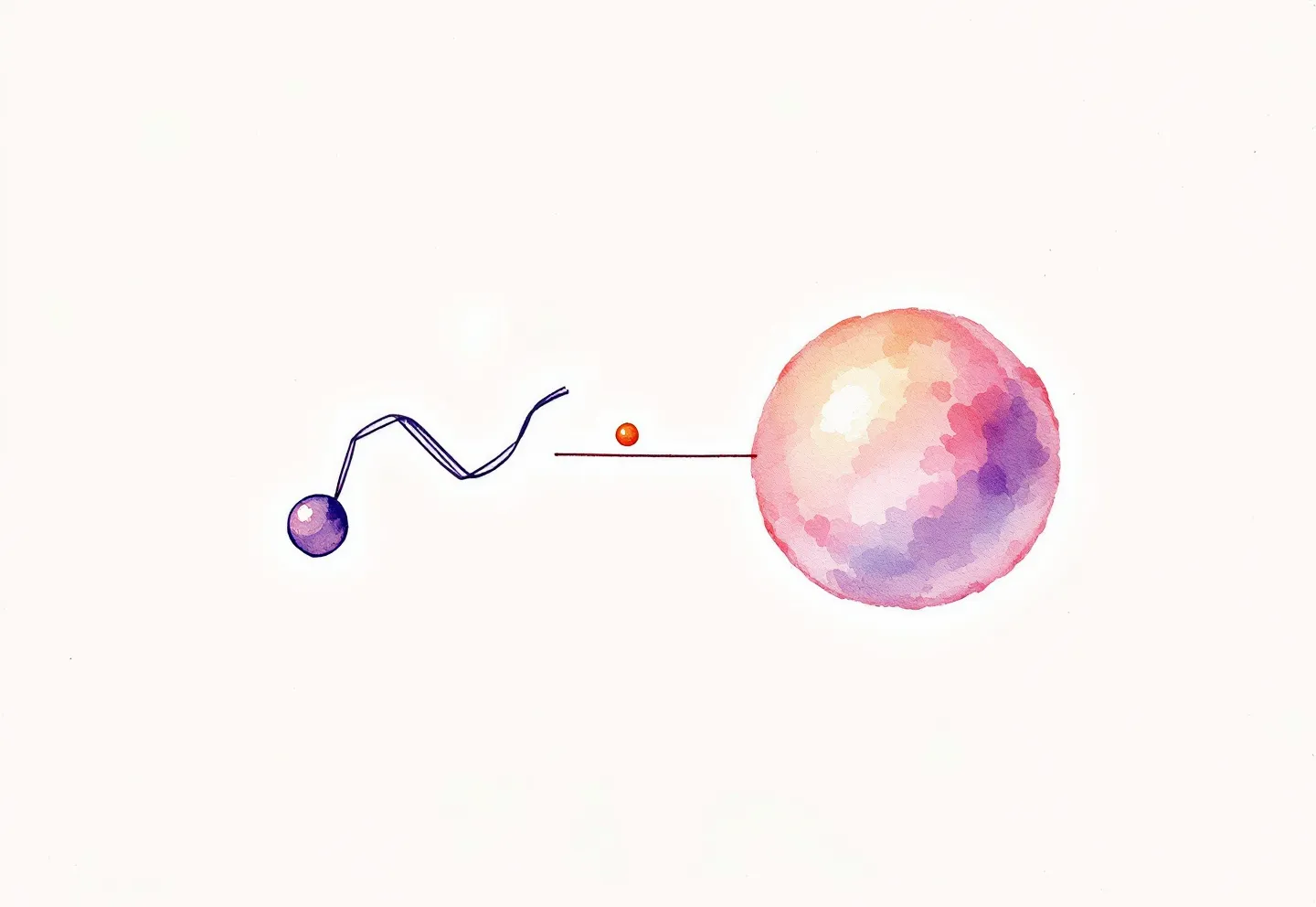
The long-acting variant — the molecule that carries the CJC-1295 name in the published literature — adds one more piece: a maleimidopropionic acid linker at the C-terminus. After a subcutaneous injection, that maleimide finds the free thiol on cysteine 34 of circulating serum albumin and forms a covalent bond. The peptide becomes part of an albumin bioconjugate, and the chemistry of albumin clearance — slow, multi-day — becomes the chemistry of the drug [1].
The published mean plasma half-life in healthy adults runs between 5.8 and 8.1 days [3]. That single fact is what makes CJC-1295 worth reading about. Almost everything else — the dosing intervals, the regulatory questions, the doping concerns — falls out of it.
What the published research shows
The human evidence base is narrow but specific.
In 2005, Jetté and colleagues at ConjuChem published the discovery paper in Endocrinology. They characterized the albumin bioconjugates of hGRF(1-29) and identified CJC-1295 as the lead long-acting candidate. A single subcutaneous bolus in rats produced a fourfold increase in growth hormone area-under-curve over two hours, and bioactivity persisted in circulation for more than seventy-two hours [1].
One year later, Teichman and colleagues — including Lawrence Frohman, who had been working on GHRH biology for two decades — published the Phase 1 human study in the Journal of Clinical Endocrinology and Metabolism. In randomized, placebo-controlled cohorts of healthy adults, single subcutaneous doses at 30, 60, 125, and 250 μg/kg produced dose-dependent increases in mean plasma GH of two- to tenfold sustained for at least six days. Mean IGF-1 rose 1.5 to 3-fold for nine to eleven days. Multiple-dose cohorts maintained IGF-1 elevation for up to twenty-eight days [2][3].
A companion paper by Ionescu and Frohman addressed an obvious objection: if you stimulate the somatotropic axis continuously, do you flatten the natural pulsatile rhythm of GH release? The answer, in that small pharmacodynamic substudy, was no. A single dose raised the basal trough GH approximately 7.5-fold while preserving normal pulse architecture, with mean GH approximately 46 percent above baseline [4]. Pulsatility persisted — a finding that distinguishes the GHRH-analog pharmacology from exogenous recombinant growth hormone.
A 2009 proteomic substudy by Sackmann-Sala identified five differentially expressed serum proteins one week after a single CJC-1295 injection in eleven healthy young men, including changes in apolipoprotein A1 and transthyretin and a correlation between immunoglobulin and albumin-fragment signals and IGF-1 levels [6]. It is one of the few published characterizations of downstream biomarker dynamics in human exposure.
That is the bulk of the peer-reviewed human record.
The trial that did not finish
There was supposed to be more.
ClinicalTrials.gov record NCT00267527 describes a Phase 2 study of CJC-1295 in 192 adults with HIV-associated visceral obesity, dosed weekly by subcutaneous injection. In October 2006, the trial was terminated after a participant died from an acute coronary event approximately two hours after receiving the eleventh weekly dose. An independent review attributed the event to pre-existing undiagnosed coronary artery disease and judged it unrelated to study drug [7].
The program did not restart. The sponsor, ConjuChem Biotechnologies, did not advance the molecule further. The primary efficacy endpoints were never published in a peer-reviewed journal. Two decades later, the absence of that Phase 2 paper is the central gap in the CJC-1295 literature.
The class continued without it. Tesamorelin, a different modified-GRF(1-29) analog without the DAC tether, was approved in 2010 for HIV-associated lipodystrophy on the strength of randomized clinical-trial data showing a 15-20 percent reduction in visceral adipose tissue over 26 weeks of daily subcutaneous dosing [17]. Tesamorelin remains the only GHRH analog approved by the FDA. CJC-1295 does not.
Where the record stands now
CJC-1295 is not approved for any human indication. The Phase 1 data exist; the Phase 2 data do not. The regulatory tail of the molecule is, at this point, more recent than its clinical history.
The FDA's Pharmacy Compounding Advisory Committee — the body that advises on which bulk drug substances 503A compounding pharmacies may use — reviewed CJC-1295 at its October 29, 2024 meeting. The committee considered the available pharmacology, clinical, and post-marketing literature for both the DAC and non-DAC variants and did not recommend inclusion on the Section 503A bulk drug substances list [14]. A follow-up meeting on December 4, 2024 consolidated public comment and adverse-event signal review for the growth-hormone-secretagogue class — CJC-1295 and ipamorelin among them — and reiterated insufficient evidence to support routine 503A compounding access [15].
Under the World Anti-Doping Code, CJC-1295 sits on the 2025 Prohibited List under Section S2, prohibited at all times for any athlete subject to WADA testing [16]. The analytical chemistry of detection — nano-LC mass spectrometry methods sensitive enough to find sub-nanogram-per-milliliter concentrations in urine — has been validated and is now part of routine doping control [12].
The practical observation: the word "prescribed" in this domain name is editorial framing, not a claim. CJC-1295 is not legally prescribable to patients in the United States. The molecule exists in the literature, in seized analytical samples [11], in research-chemical channels, and in regulatory documents. It does not exist in pharmacies.
What this site is
Prescribed CJC-1295 is a case file. It reads the peer-reviewed and regulatory record on a research peptide that has, for almost twenty years, lived in an unusual zone: real published pharmacology, no completed Phase 2, no approved indication, broad availability outside pharmaceutical channels.
Everything on the site is sourced. The research findings on the next page cite the original PubMed-indexed studies. The dosage page reports the doses used in those studies, in research-context only, with the species, route, and duration each was administered. The references page lists every citation with its DOI and URL.
The site does not sell anything. It is affiliated with no vendor, manufacturer, compounding pharmacy, telehealth provider, or research-chemical supplier. It reads the published record and cites it.